GateHouse News Service Posted Jan 24, 2012 @ 03:17 PM
Springfield, Ill. — Governor Pat Quinn today announced $21.7 million in Illinois Safe Routes to School grants to schools and communities across the state. The federally-funded program is designed to enable and encourage children to walk and bike to school safely.
“These projects enhance roads, sidewalks, and other infrastructure within communities, which is important in keeping both drivers and pedestrians safe,” Governor Quinn said. “Encouraging children to walk and bike to school not only makes school routes safer, but also improves the quality of life for Illinois residents by easing traffic congestion and reducing emissions.”
The 229 funded projects support sidewalk repair and equipment for police and crossing guards. The funding includes $1.5 million to assist communities with safety training, educational materials, and public service announcements encouraging safe walking and biking to school. This will help ensure a consistent statewide program and favorable outcomes from the Safe Routes to Schools projects.
“The Illinois Safe Routes to School grants help us build pedestrian-friendly roads and sidewalks while educating students and families on the importance of alternative forms of transportation and the benefits of an active lifestyle,” Illinois Transportation Secretary Ann Schneider said. “With these funds, we are also able to help communities implement projects aimed at lowering fuel consumption and air pollution.”
“This is exciting news for the entire state,” said Ron Burke, Executive Director of the Active Transportation Alliance, an advocacy organization that works to improve conditions for biking, walking and public transportation. “When we make bicycling and walking to school safer and more convenient, we are making our air cleaner and helping more kids get active and healthy.”
Illinois Safe Routes to School is a program of the U.S. Department of Transportation’s Federal Highway Administration, designed to enable and encourage children, including those with disabilities, to walk and bicycle to school and encourage a healthy lifestyle from an early age. The program also facilitates projects and activities that will improve safety and reduce traffic, fuel consumption, and air pollution in the vicinity of primary and middle schools.
For more information about the Illinois Safe Routes to School Program and to view a list of funded projects, visit http://www.dot.il.gov/saferoutes/SafeRoutesHome.aspx.
Aledo Times Record: http://www.aledotimesrecord.com/news/x767703643/Governor-Quinn-announces-21-7-million-award-to-create-Safe-Routes-to-School
Tuesday, January 31, 2012


Monday, January 30, 2012
The Personal is Political: Why Preventative Health Policies Matter
Editor’s Note: Rebecca Portman is interning with the American Heart Association Chicago office this semester. She is a student at Northwestern University who started her internship with us at the beginning of the year. Her responsibilities include contributing weekly to this blog. Please enjoy her latest post.
The Personal is Political: Why Preventative Health Policies Matter

When I left home for Northwestern in the fall of 2009, I saw college as an opportunity to figure out what I really cared about and wanted to devote my time to. I had chosen to major in Social Policy, but I had little idea of what that really meant or what type of policy I was interested in working on.
On a personal level, as freshman year began I struggled to find balance in my life. I felt the need to make friends, establish myself as a future leader in a student group (or two or three), and do well in classes. I had retired from my career as a competitive ice hockey player, and the lure of all-you-can-eat buffet style dining halls and Friday night “hot cookie bar” began to take a toll on my health.
I wish I could say there was a life-changing moment when I realized my mistakes and decided to take control of my health once and for all. But in reality, my fitness awakening happened sporadically. It has taken two and a half years of trying and failing and trying again at making healthy eating and exercise consistent for me to ultimately find a place of balance, moderation, and comfort with my health. I’ve come to realize that my personal wellbeing will always be a work in progress. In the process, however, fitness has become not just a priority, but also a passion.
Here’s where things get complicated: not everyone wants to spend as much time as I do reading about antioxidants or making complex workout plans. Most people don’t want to count calories, can’t afford a personal trainer or expensive gym membership, and couldn’t tell the difference between healthy and unhealthy fats. As I tried to lead a healthy lifestyle, it became more and more apparent that by doing so, I was actually going against the accepted norm—not just of stereotypical pizza-eating, beer-drinking college students, but of the majority of Americans. Our national holidays celebrate overeating, our supermarkets are filled with processed, sugary food products, and our national pastime is watching television. It is no wonder that 33% of American adults are obese (28% of Illinoisans), when poor health has become so embedded in our culture. Temptation is everywhere -- even here at the AHA!
It struck me: if it is so difficult for me to resist temptation and take good care of myself, how much harder must it be for other people with real responsibilities, financial difficulties or pre-existing health conditions? I struggle to stay healthy despite having the luxuries of abundant free time, access to an upscale gym facility on campus, and did I mention I live next door to a Whole Foods Market? So how can I possibly expect a single mother or father who works two jobs to overcome the monumental obstacles that stand in the way of good health?
Suddenly I had an answer to the looming question of what type of policy I wanted to work on. My seemingly personal problem was part of a greater societal ill, and I could do something about it not just for me but for everyone who has struggled to live a healthy lifestyle, if I worked to implement policies that promote good health and prevent obesity. I’m not suggesting that everyone needs to eat a perfect diet or have six-pack abs. But in order to improve individual health on a grand-scale, we have to implement policies that bring us closer to being a society where fitness and nutrition receive positive and frequent reinforcement.
In the past two weeks, I have been excited to see just how much the Illinois Health Strategies team is doing to bring about the kind of healthy environment I would like to see one day. I helped to prepare a fact sheet to bolster the AHA’s efforts to eliminate waivers exempting schools from the statewide mandate for Physical Education in Illinois. I watched AHA volunteer Sandy Noel share her enthusiasm for health as a newly appointed chair of the Governor’s Council on Health and Physical Fitness. I assisted in the planning of two events that will bring members of Chicagoland Latino and African American communities together to learn about nutrition and get screened for health risks. As I have gotten settled in at the office, I have found it extremely rewarding to be able to do substantive work that I know is going towards a cause I believe in, and to spend time on something that matters to me—both personally and politically.
The Personal is Political: Why Preventative Health Policies Matter

When I left home for Northwestern in the fall of 2009, I saw college as an opportunity to figure out what I really cared about and wanted to devote my time to. I had chosen to major in Social Policy, but I had little idea of what that really meant or what type of policy I was interested in working on.
On a personal level, as freshman year began I struggled to find balance in my life. I felt the need to make friends, establish myself as a future leader in a student group (or two or three), and do well in classes. I had retired from my career as a competitive ice hockey player, and the lure of all-you-can-eat buffet style dining halls and Friday night “hot cookie bar” began to take a toll on my health.
I wish I could say there was a life-changing moment when I realized my mistakes and decided to take control of my health once and for all. But in reality, my fitness awakening happened sporadically. It has taken two and a half years of trying and failing and trying again at making healthy eating and exercise consistent for me to ultimately find a place of balance, moderation, and comfort with my health. I’ve come to realize that my personal wellbeing will always be a work in progress. In the process, however, fitness has become not just a priority, but also a passion.
Here’s where things get complicated: not everyone wants to spend as much time as I do reading about antioxidants or making complex workout plans. Most people don’t want to count calories, can’t afford a personal trainer or expensive gym membership, and couldn’t tell the difference between healthy and unhealthy fats. As I tried to lead a healthy lifestyle, it became more and more apparent that by doing so, I was actually going against the accepted norm—not just of stereotypical pizza-eating, beer-drinking college students, but of the majority of Americans. Our national holidays celebrate overeating, our supermarkets are filled with processed, sugary food products, and our national pastime is watching television. It is no wonder that 33% of American adults are obese (28% of Illinoisans), when poor health has become so embedded in our culture. Temptation is everywhere -- even here at the AHA!
It struck me: if it is so difficult for me to resist temptation and take good care of myself, how much harder must it be for other people with real responsibilities, financial difficulties or pre-existing health conditions? I struggle to stay healthy despite having the luxuries of abundant free time, access to an upscale gym facility on campus, and did I mention I live next door to a Whole Foods Market? So how can I possibly expect a single mother or father who works two jobs to overcome the monumental obstacles that stand in the way of good health?
Suddenly I had an answer to the looming question of what type of policy I wanted to work on. My seemingly personal problem was part of a greater societal ill, and I could do something about it not just for me but for everyone who has struggled to live a healthy lifestyle, if I worked to implement policies that promote good health and prevent obesity. I’m not suggesting that everyone needs to eat a perfect diet or have six-pack abs. But in order to improve individual health on a grand-scale, we have to implement policies that bring us closer to being a society where fitness and nutrition receive positive and frequent reinforcement.
In the past two weeks, I have been excited to see just how much the Illinois Health Strategies team is doing to bring about the kind of healthy environment I would like to see one day. I helped to prepare a fact sheet to bolster the AHA’s efforts to eliminate waivers exempting schools from the statewide mandate for Physical Education in Illinois. I watched AHA volunteer Sandy Noel share her enthusiasm for health as a newly appointed chair of the Governor’s Council on Health and Physical Fitness. I assisted in the planning of two events that will bring members of Chicagoland Latino and African American communities together to learn about nutrition and get screened for health risks. As I have gotten settled in at the office, I have found it extremely rewarding to be able to do substantive work that I know is going towards a cause I believe in, and to spend time on something that matters to me—both personally and politically.
City of Chicago 2012 Proclamation for Wear Red Day
 Mayor Rahm Emanuel has proclaimed February 3, 2012 as National Wear Red in the City of Chicago and is urging all Chicagoans to show their support for women and the fight against heart disease by wearing red on that day.
Thursday, January 26, 2012
Meijer and AHA Healthy Living Poster Contest
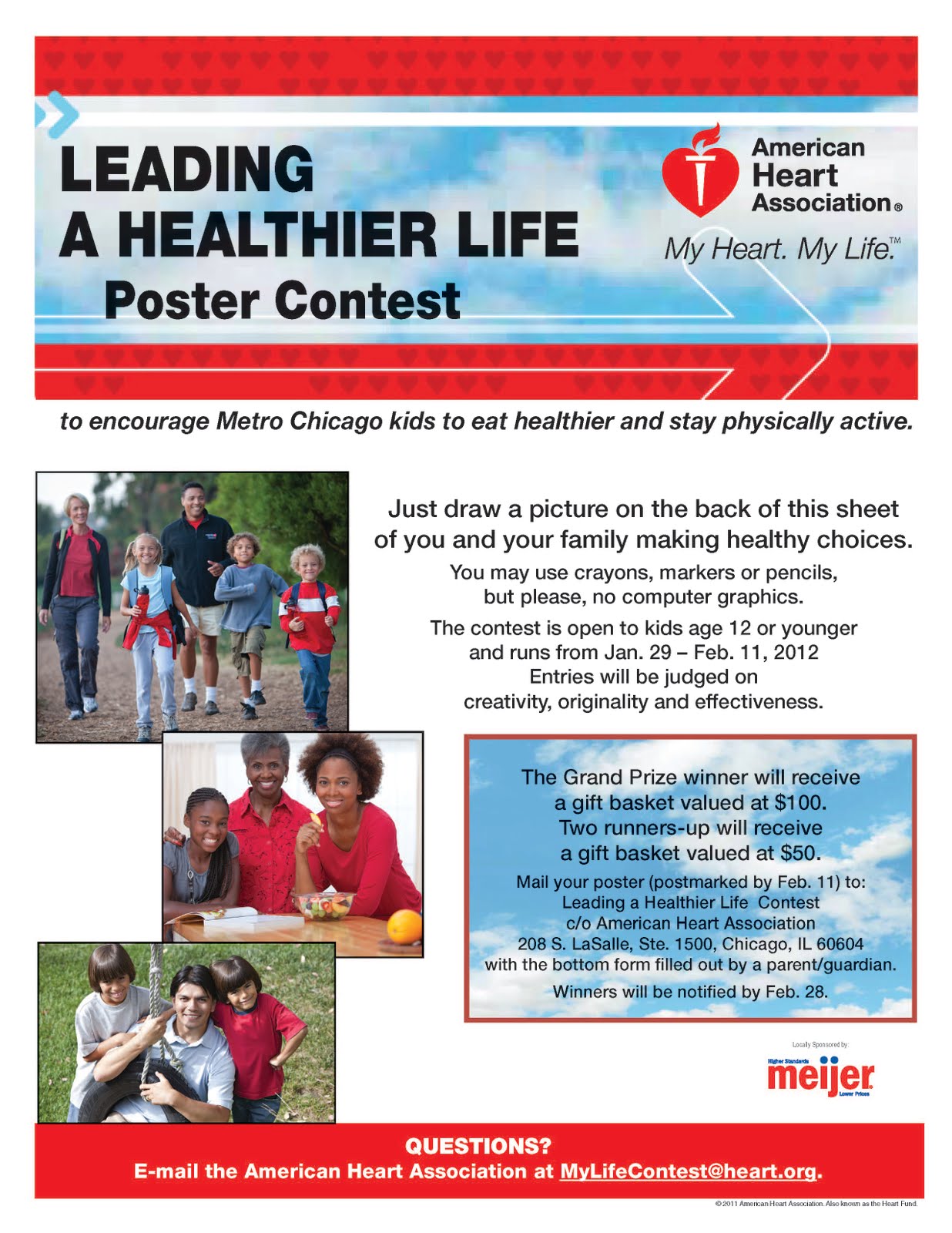 Leading a Healthier Life Poster Contest to encourage Chicago kids to eat healthier and stay physically active.
Just draw a picture of you and your family making healthy choices.
You may use crayons, markers or pencils, but no computer graphics.
The contest is open to kids age 12 or younger and runs from January 29 - February 11, 2012.
Entries will be judged on creativity, originality and effectiveness.
The Grand Prize winner will receive a gift basket valued at $100.
Two runners-up will receive a gift basket valued at $50.
Mail your poster (postmarked by Feb. 11) to:
Leading a Healthier Life Contest
c/o American Heart Association
208 S. LaSalle, Ste. 1500, Chicago, IL 60604
with the bottom form filled out by a parent/guardian.
Winners will be notified by Feb. 28.
Questions? Email the American Heart Association at MyLifeContest@heart.org.
Monday, January 23, 2012
SSEEO Teleconference- Pseudo bulbar Affect or Involuntary Emotional Expressive Disorder (IEED)

Stroke Survivors Empowering Each Other (SSEEO) invites you to join a call-in support group for stroke survivors and their caregivers!
The SSEEO Toll-Free Telephone Stroke Support Group builds community, provides support and shares information by connecting survivors, caregivers, health professionals and other stroke stakeholders. The calls last approximately 60 minutes with the last 30 minutes reserved for questions and conversation. Please don’t forget to register by following the instructions below.
Tuesday, February 14th, 12:00-1:00pm central time: Pseudobulbar Affect or Involuntary Emotional Expression Disorder (IEED) presented by Dr. Melvin Wichter from Advocate Christ Medical Center. Dr Wichter will discuss a condition in which a person experiences uncontrollable episodes of emotional expression. That is, they have episodes of crying, laughter, or anger that are not in line with their present mood. IEED is seen most often following brain injury or in people with dementia, motor neuron disease, multiple sclerosis and traumatic brain injury. It can appear at any stage of the associated diseases.
Dr. Melvin Wichter, MD is a board certified neurologist who has practiced in the south suburban area since 1977. Dr. Wichter graduated from New York Medical College and completed his residency at New York University. At Advocate Christ Medical Center in Oak Lawn Illinois, he is the Chief of the Neurology Department and was instrumental in the development of the stroke program. He is a well known educator, lecturer and mentor to his medical students and residents. During the course of his career he has been involved in many clinical studies and authored many articles about neurological conditions. His clinical interests include stroke and use of thrombolytic agents and ethics in medicine. He is a strong advocate for his patients always spending time educating staff, patients and families and offers emotional support.
IMPORTANT CALL-IN INFORMATION: Participation on the calls is absolutely free but advance registration is required due to limited line availability. Please contact us at 1-888-988-8047 or christine@sseeo.org and provide the following information: first and last name(s), mailing address, e-mail address and telephone number. We will get back to you with an 800 call-in number and pass code, which will allow you to access the conference call. Registration deadline is February 13th.
The SSEEO Toll-Free Telephone Stroke Support Group builds community, provides support and shares information by connecting survivors, caregivers, health professionals and other stroke stakeholders. The calls last approximately 60 minutes with the last 30 minutes reserved for questions and conversation. Please don’t forget to register by following the instructions below.
Tuesday, February 14th, 12:00-1:00pm central time: Pseudobulbar Affect or Involuntary Emotional Expression Disorder (IEED) presented by Dr. Melvin Wichter from Advocate Christ Medical Center. Dr Wichter will discuss a condition in which a person experiences uncontrollable episodes of emotional expression. That is, they have episodes of crying, laughter, or anger that are not in line with their present mood. IEED is seen most often following brain injury or in people with dementia, motor neuron disease, multiple sclerosis and traumatic brain injury. It can appear at any stage of the associated diseases.
Dr. Melvin Wichter, MD is a board certified neurologist who has practiced in the south suburban area since 1977. Dr. Wichter graduated from New York Medical College and completed his residency at New York University. At Advocate Christ Medical Center in Oak Lawn Illinois, he is the Chief of the Neurology Department and was instrumental in the development of the stroke program. He is a well known educator, lecturer and mentor to his medical students and residents. During the course of his career he has been involved in many clinical studies and authored many articles about neurological conditions. His clinical interests include stroke and use of thrombolytic agents and ethics in medicine. He is a strong advocate for his patients always spending time educating staff, patients and families and offers emotional support.
IMPORTANT CALL-IN INFORMATION: Participation on the calls is absolutely free but advance registration is required due to limited line availability. Please contact us at 1-888-988-8047 or christine@sseeo.org and provide the following information: first and last name(s), mailing address, e-mail address and telephone number. We will get back to you with an 800 call-in number and pass code, which will allow you to access the conference call. Registration deadline is February 13th.
Subscribe to:
Posts (Atom)


 Posts
Posts


